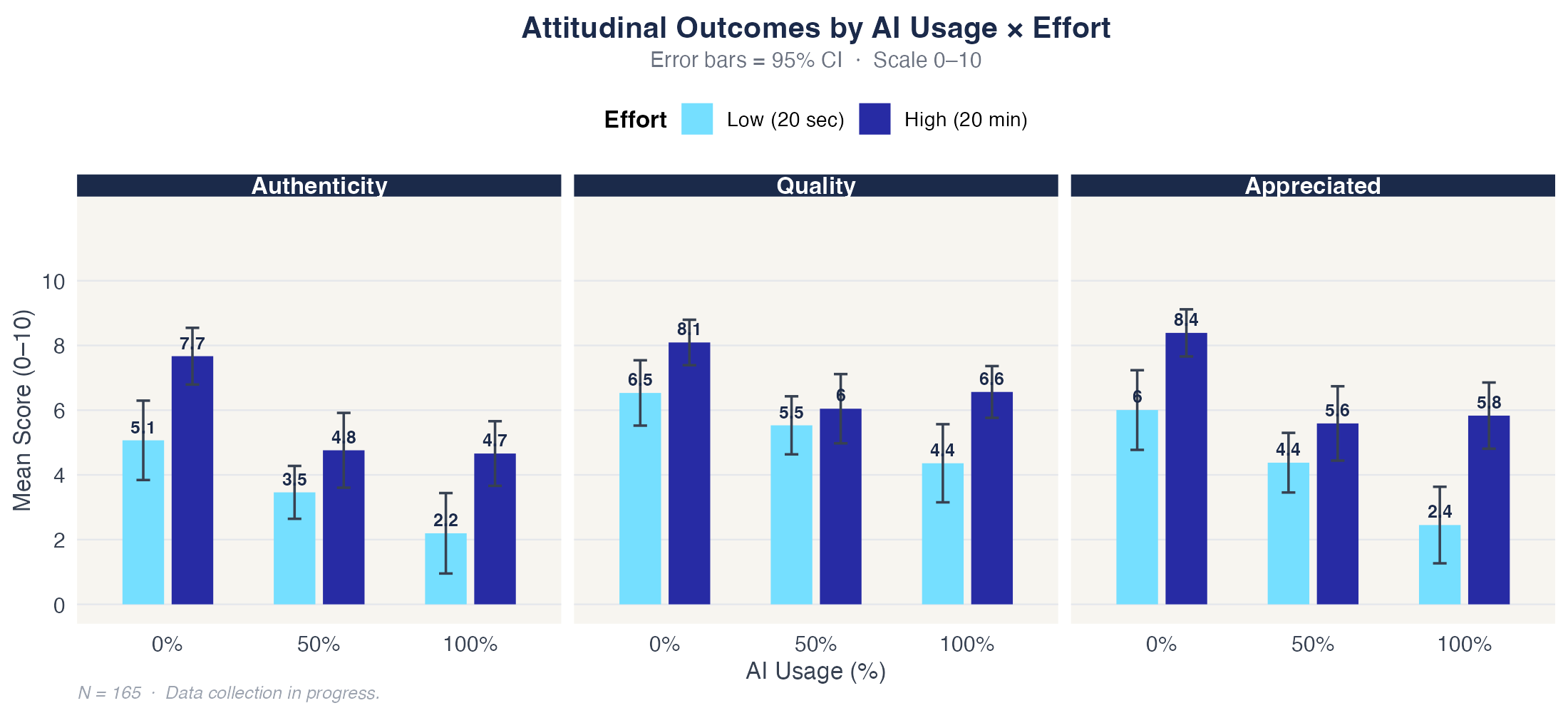
Scroll to explore

Does it matter
who wrote it?

A controlled experiment on AI-generated gratitude,
human connection, and what happens when they collide.

AI Usage: 0% · 50% · 100% Effort: 20 sec · 20 min 6 Outcome Measures N = 165 · Ongoing
Scroll to explore

Every participant read
the exact same note.

There was no quality manipulation. Everyone — regardless of condition — received this identical letter from a coworker. It was warm, specific, and well-written.

"I just wanted to take a moment to say how much I appreciate working with you. You have such a positive impact on our team — whether it's the way you approach problems, the energy you bring, or the thoughtfulness you show everyone around you. It genuinely makes a difference, and I'm really glad we get to work together."

— Your coworker

But they were told different things about it.

What varied across conditions wasn't the letter itself — it was the disclosed context of how it was made. Six groups. Same words. Different knowledge.

0%

Fully written by a human

50%

Half human, half AI

100%

Entirely written by AI

Each group was also told it took either 20 seconds or 20 minutes to produce.

This design isolates the psychological effect of knowing — not the effect of the letter's content, which was held constant.

A 2 × 3 between-subjects experiment

Participants were randomly assigned to one of six conditions. No one saw multiple versions of the note.

Factor A — AI Usage
0% · 50% · 100%

How much of the note was AI-generated

Factor B — Effort
20 sec · 20 min

How long the sender spent on it

Authenticity (0–10) — how genuine the note felt
Quality (0–10) — how well-written the note seemed
Felt Appreciated (0–10) — how valued the recipient felt
Lunch allocation (−100 to +100) — time toward coworker vs. work
Change in felt connection from pre-study baseline
AI reciprocity — would you use AI to write a response?
01

Any AI use
contaminates authenticity.

Going from 0% to just 50% AI causes a larger drop in perceived authenticity than almost any other factor — regardless of how much effort was disclosed. The floor drops immediately.

7.7
Human · high effort
4.8
50% AI · high effort
2.2
100% AI · low effort

Even 20 minutes of disclosed effort can't bring a 100% AI note back to where a careless human starts. The contamination is immediate.
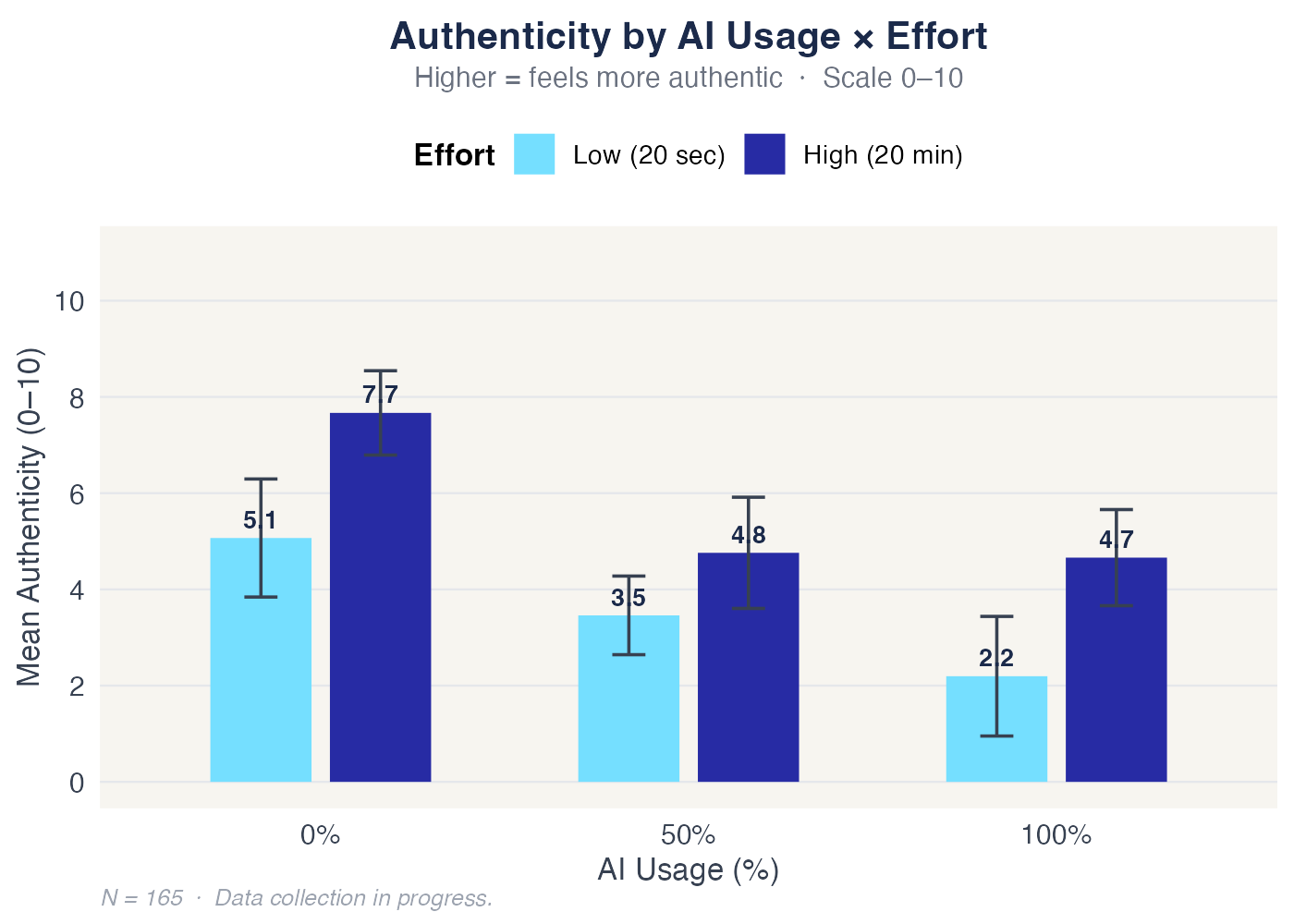
Authenticity by AI Usage × Effort
02

Same note. Completely
different meaning.

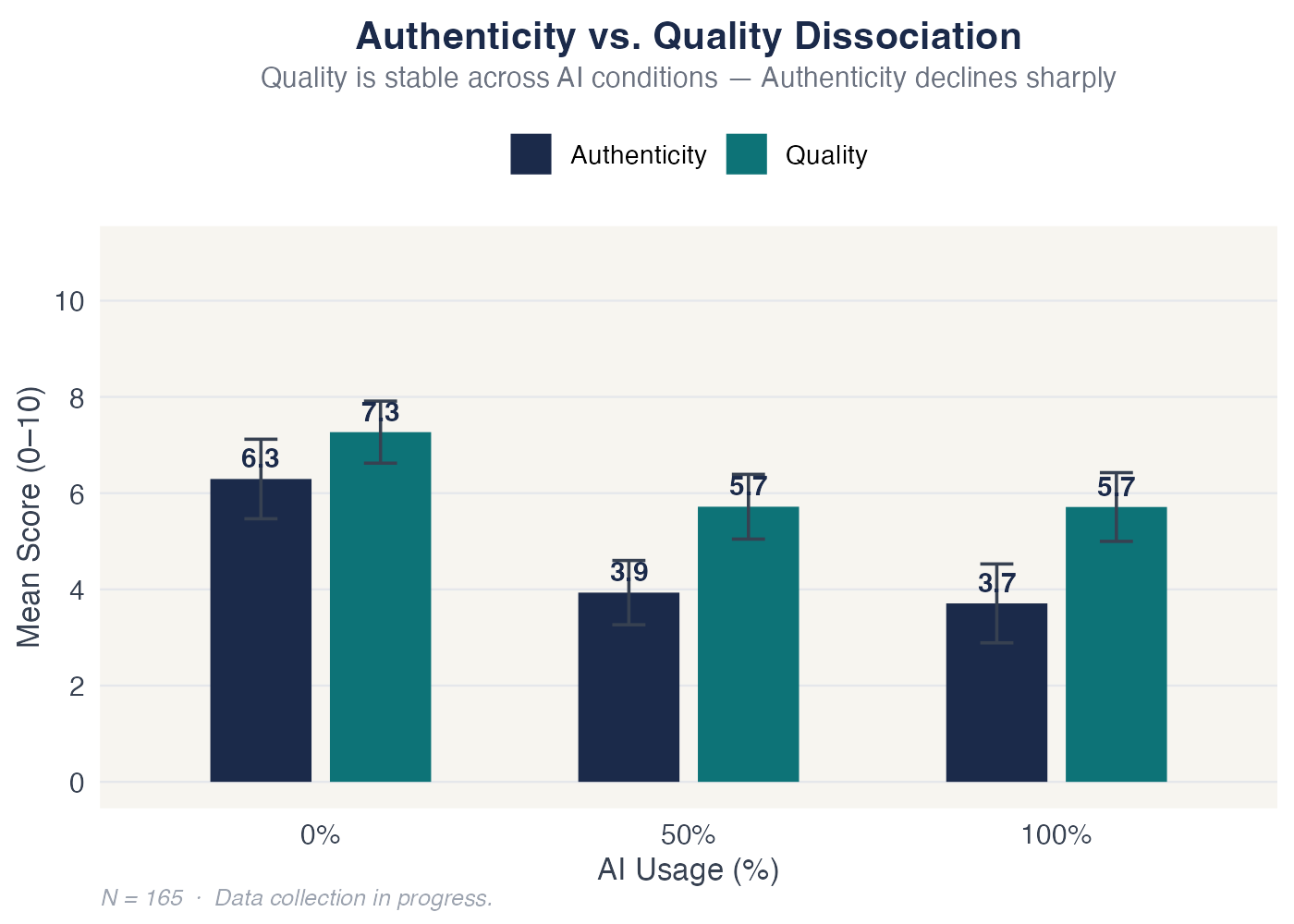
Authenticity vs. Quality Dissociation

Because everyone read the same letter, quality ratings barely move across conditions — people are evaluating identical text. But authenticity collapses the moment AI is disclosed.

This dissociation is the core finding. It's not about what was written. It's about who we believe was behind it.

5.7

Quality at 50% & 100% AI — nearly unchanged

3.7–3.9

Authenticity at the same conditions

Quality ≠ Care. People can rate a note as well-written while simultaneously feeling it meant nothing. The craft and the intent are now separable in a way they never were before AI.

03

Effort helps — but can't
close the gap.

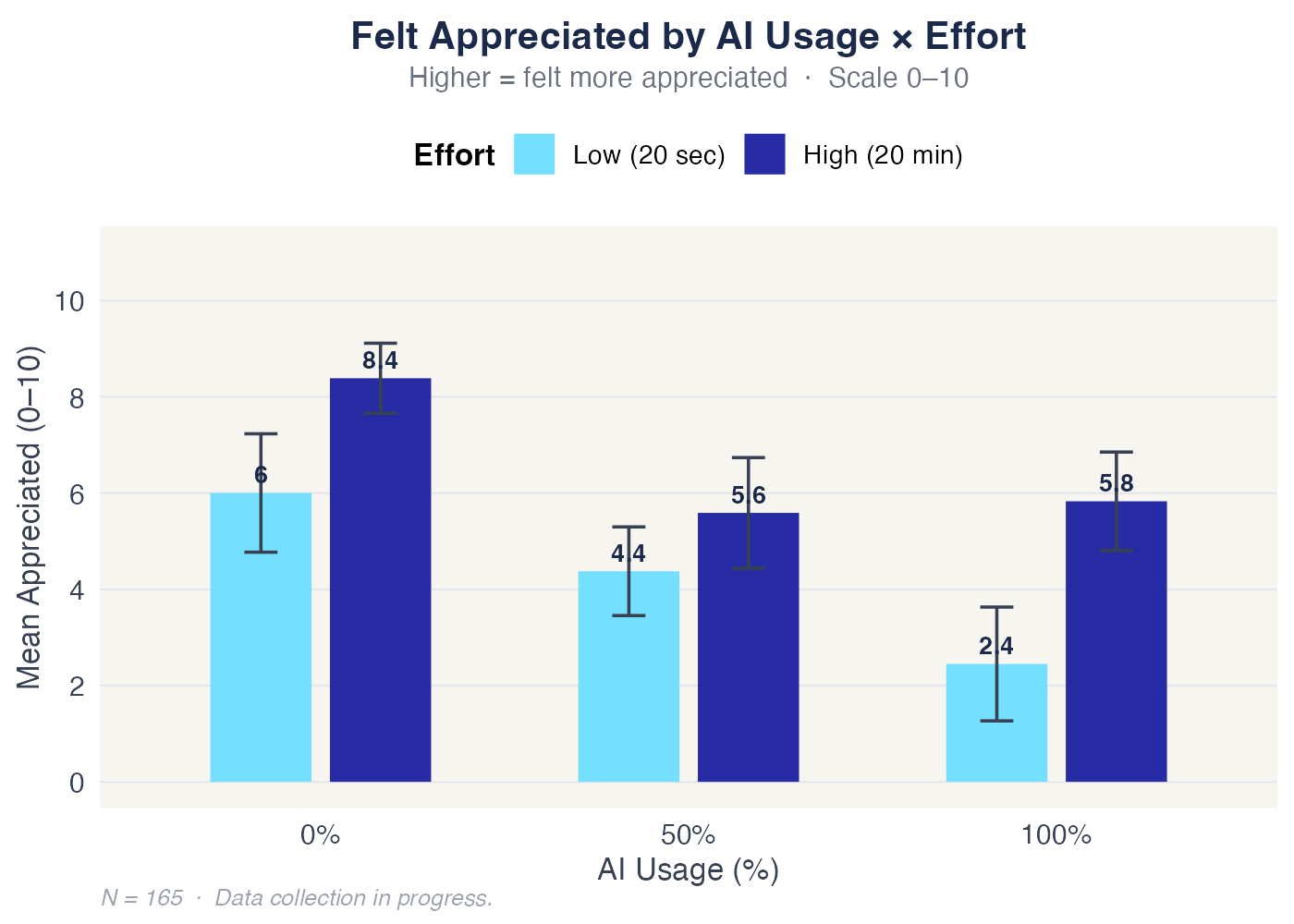
Disclosing high effort (20 minutes) partially rescues how appreciated people feel. A fully AI-written note with high effort scores 5.8 on felt-appreciated — meaningfully higher than a quick AI note at 2.4.

But even with maximum effort, no AI condition reaches the baseline set by a human note written quickly. The ceiling of AI + effort is the floor of human.

0% AI · High Effort
8.4
felt appreciated
100% AI · High Effort
5.8
felt appreciated
100% AI · Low Effort
2.4
felt appreciated

The worst combination — fully AI, dashed off fast — doesn't just fail to land. It scores so low it may be worse than no note at all.

Felt Appreciated by AI Usage × Effort
04

This isn't just a feeling.
It changes behavior.

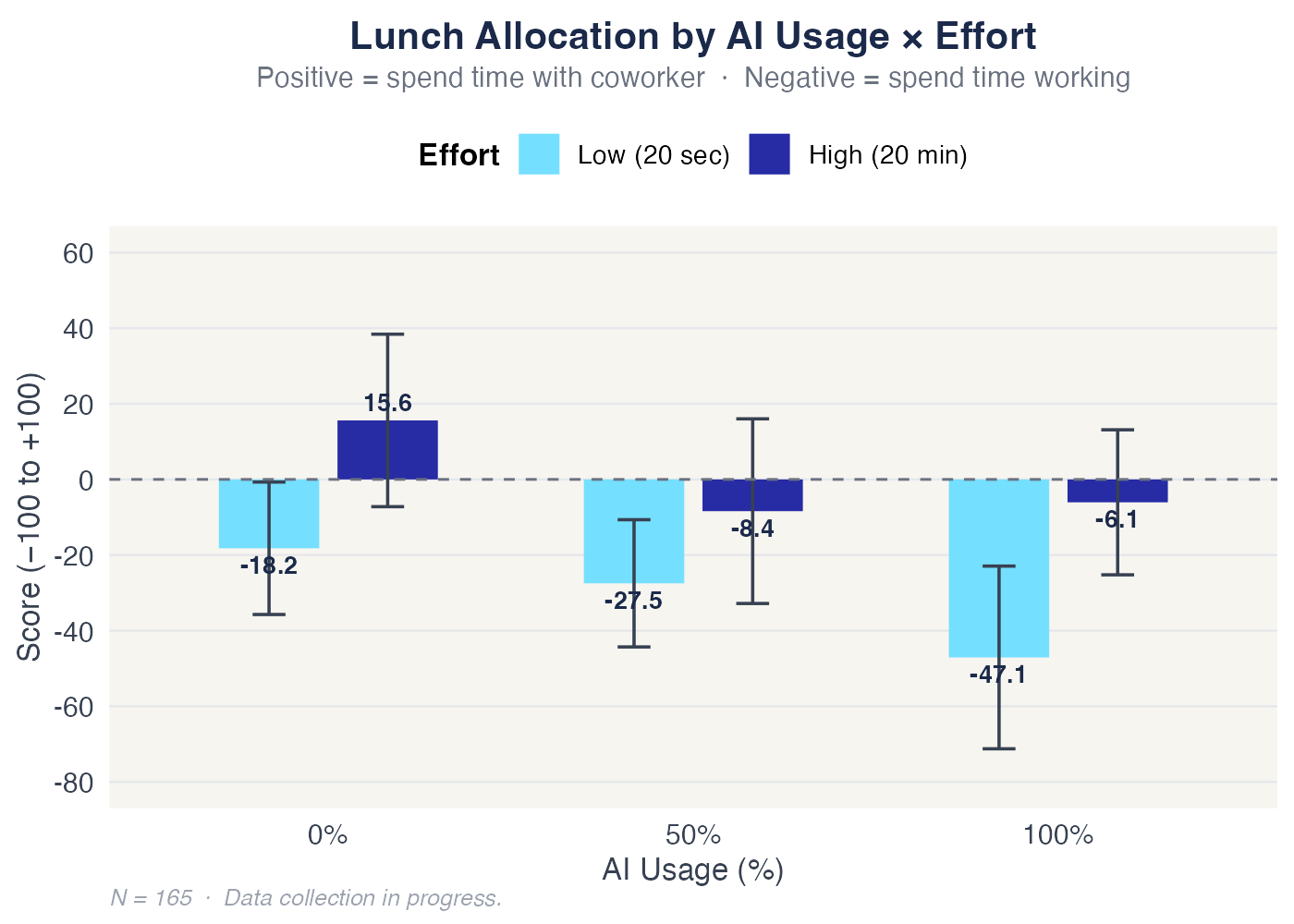
After reading the note, participants decided how to spend their lunch break — with the coworker who sent it, or working alone. The scale runs from −100 (work alone) to +100 (spend time with coworker).

0% AI · High Effort
+15.6
→ choose to spend time with them
100% AI · Low Effort
−47.1
→ actively avoid them at lunch

A 62-point swing between the best and worst condition. The same warm, well-written note — disclosed as AI-generated and quick — drives people to actively avoid the sender.

Lunch Allocation by AI Usage × Effort
05

Real connection requires
real humans, investing real time.

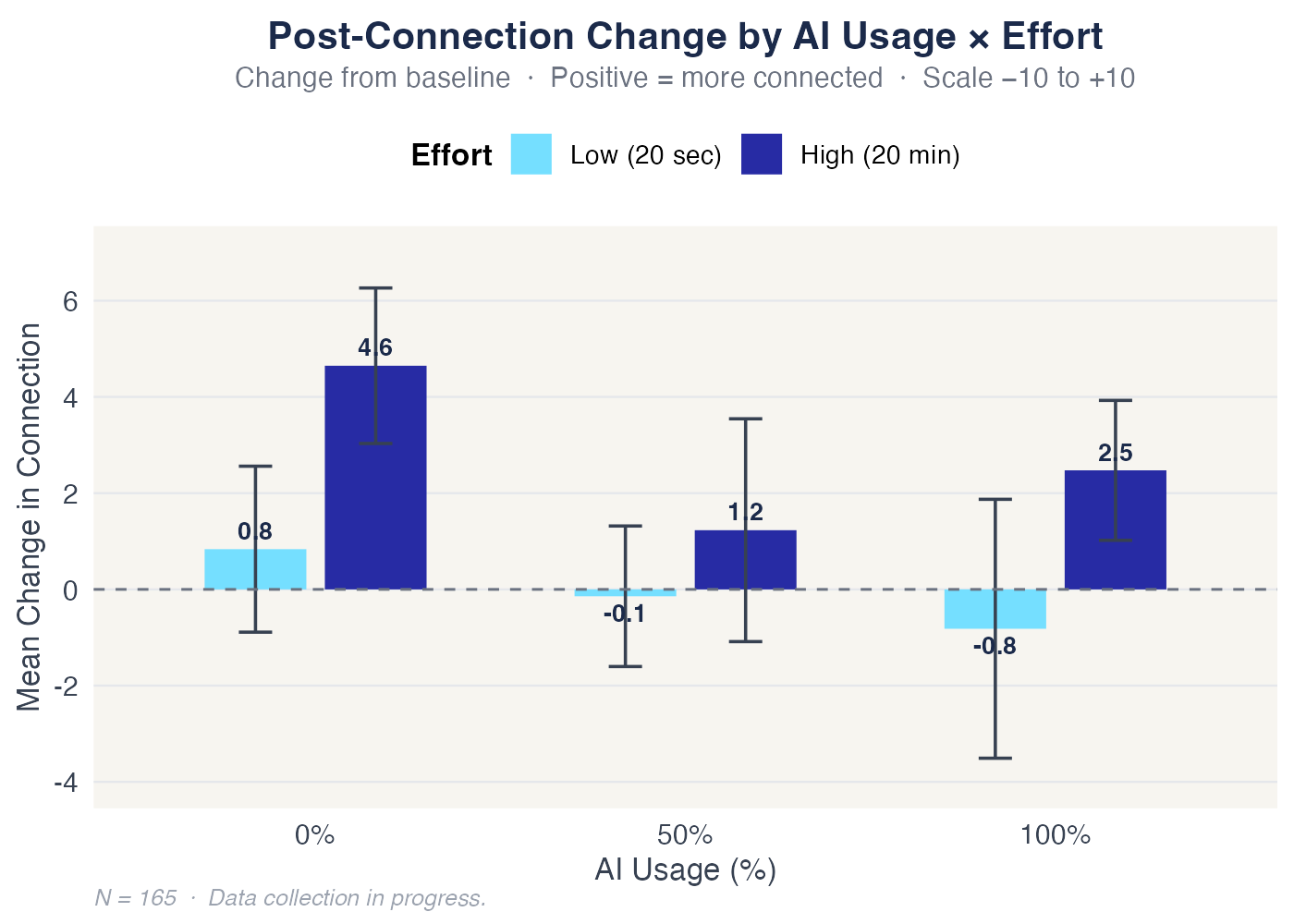
Post-Connection Change by AI Usage × Effort

Measuring change in felt connection from a pre-study baseline, only one condition produced a meaningful boost: a human note written with care. Everything else was flat or went below zero.

0% AI · High Effort +4.6
100% AI · High Effort +2.5
50% AI · Low Effort −0.1
100% AI · Low Effort −0.8

An AI note sent in haste doesn't just fail to connect — it erodes the connection that already existed.

06

When you receive AI,
you respond with AI.

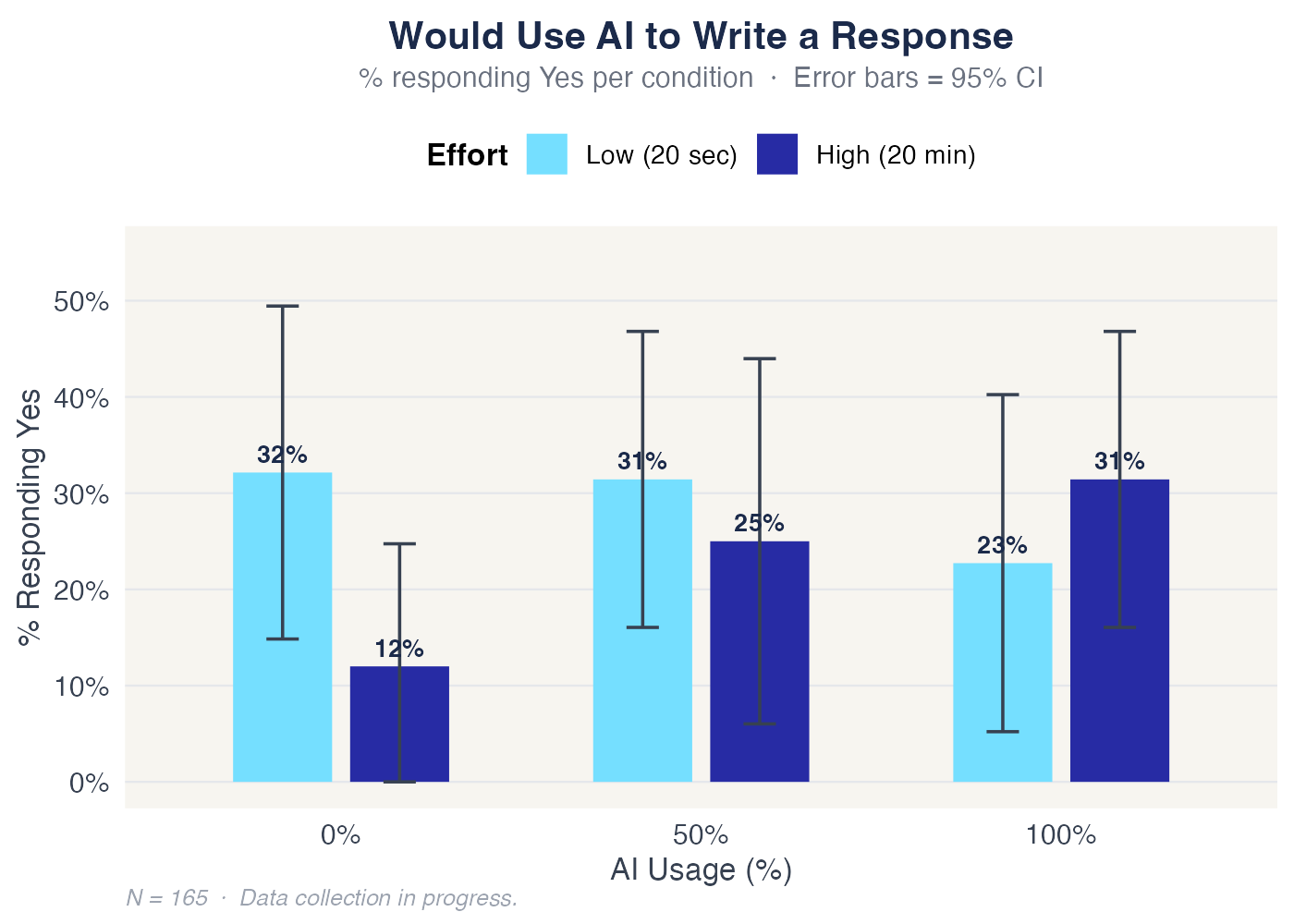
Participants who received a 100% AI note (high effort) were just as likely to use AI in their own written response — 31% — as those who received a quick, careless human note (32%).

Receiving AI-generated appreciation normalizes using AI in return. The social norm around human effort in relationships starts to unravel.

"If you're not really writing to me, I'm not really writing back."

The spiral: AI gratitude normalizes AI responses → norms around human effort erode → everyone gradually opts out of genuine connection. Not with a bang, but with a polite, well-written automated reply.

Note: wide CIs suggest this finding warrants more data, but the directional pattern is consistent.

Would Use AI to Write a Response

The pattern is consistent
across every measure.

Effort amplifies. AI erodes. They don't fully cancel each other out.

Authenticity, Quality, and Appreciated — all conditions

There is no threshold.

Any amount of AI disclosure is enough to contaminate perceived authenticity. Effort is a partial antidote — but it cannot restore what only a human touch provides. The "drop of blood" hypothesis holds.

−3.8
Authenticity drop
at first AI disclosure
−47.1
Lowest behavioral
allocation score
+4.6
Peak connection boost
(human, high effort)

So what do we do about it?

The data points toward a new norm for AI-assisted communication at work — and a more honest reckoning with what gratitude is actually for.

For senders

When appreciation matters, write it yourself. The time investment is the signal — and that's the entire point of a thank-you. Optimizing the output misses the point of the act.

For teams & managers

AI gratitude normalizes AI responses. Establish norms around authentic recognition before the reciprocity spiral takes hold in your culture. Psychological safety and connection are downstream of this.

For researchers

Quality and authenticity are dissociating in the AI era. Measuring "quality" alone misses the deeper relational cost of automating care. New scales for perceived intent and effort attribution are needed.

N = 165  ·  Data collection in progress  ·  Error bars = 95% CI

Elizabeth Kim  ·  2026